

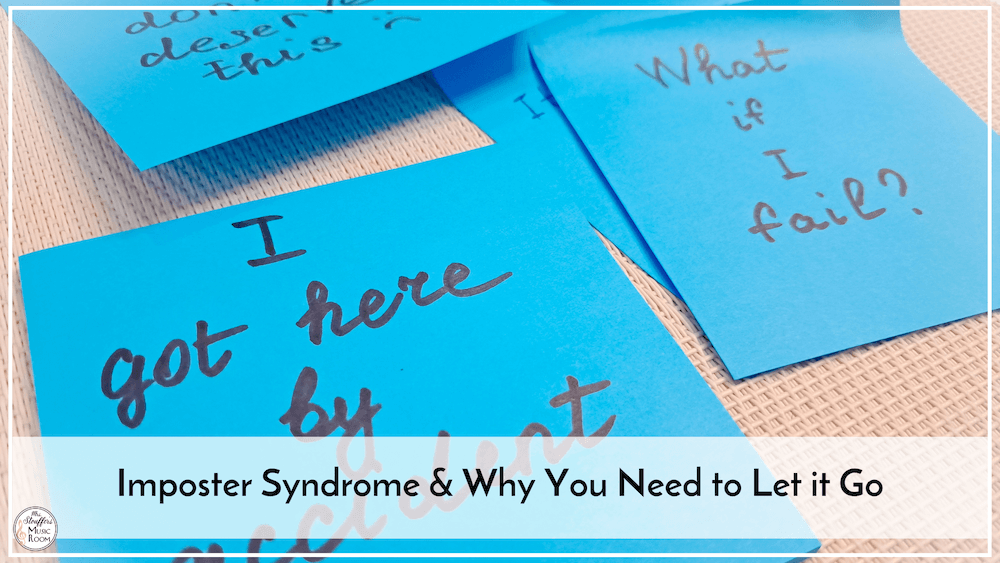
Imposter Syndrome can be debilitating for people. It’s something that lots of teachers can experience, especially when they are new, in a new position, or when confronted with new situations. Confession: I suffer from Imposter Syndrome. Heavily. We’ll talk about why later on but it is something I’ve learned to deal with over the years. In this post, we’ll talk tips, tricks, and what imposter syndrome is and why you need to let it go.
The Truth…
Here’s a real truth about me that I am reluctant to share but I think it’s important to the story. I didn’t get into the music program I wanted to be in the first time I tried. Or the second, the third…we won’t count the rejection letters I got. I tried several times and I still have them. I am NOT a performer and got a psychology degree while I was chasing other dreams. My prep for auditions would be fine in lessons, (with one of the faculty of the program I wanted to get into!), and I was well prepared….until I saw the “crowd” of judges and would internally freeze up. As someone who had thrived as a performer until that point (as the big fish holding a saxophone in a small pond), it really messed with my brain, self esteem, and my sense of who I was.
I was accepted into the program I wanted the same semester I walked with my B.S. in Psychology. In my audition, I had one small mistake, and promptly started swearing at myself in my head that I had blown it again and that was it. I won’t list any of the things I was telling myself because it is definitely not safe for an educator friendly site but know that it was what distracted me enough to actually perform well the rest of the audition. Who knew that a string of profanities in my brain would be what I needed as a distraction?
All that time, I had been studying with one of the faculty the number of years I was trying to get into the program. That Monday she came and pulled me out of choir to tell me I had finally made it. But even when I finally got that slot, I struggled to remind myself I was capable.
Capable when I was student teaching in a questionable situation even though I had the support of my university faculty advisor.
Capable when I was in my first job.
Capable when I was in front of a room full of Kindergarteners.
Capable when I started making resources to use in my classroom and put them on TpT.
Capable when I started a band program from scratch.
Even now, I sometimes struggle when I’m presenting, when I write a post, or when I’m trying to help other teachers. I’m not searching for a pat on the back but know that it is STILL something I deal with even though I KNOW I’m capable!
But here’s the deal. My ability to stand in front of a crowd and sing is not my ability to effectively teach students how to read, write, and enjoy music. It isn’t my ability to teach them to sing or play their own instruments. It ISN’T my ability to help kids perform. It isn’t indicative of my ACTUAL ability. It is ONLY my ability to perform when being judged.
What’s Imposter Syndrome?
Feeling like a fraud, inadequate, or extreme self doubt. When all of that is unwarranted!
Some things that can cause it:
- Comparison
- Perfectionism
- Thinking past success is luck, or a fluke.
- Things that make you doubt your expertise, or self-worth.
And it can cause problems in your job, with your relationships, and your mental health.
Let it gooooooo….
Insert Frozen meme here. But seriously. Hanging on to imposter syndrome can really cause some problems. If you are approaching things from a place of “I can’t do it, I don’t deserve this, I don’t know what I’m really doing”, at the very least, your students WILL catch onto those vibes. You might have some mental health struggles. It may alter how your colleagues see you. So face it head on and remind yourself that you are the expert.
Tips & Tricks to fight it
First, acknowledge it.
Then challenge it.
Remind yourself
- That you are a trained educator.
- Of past accomplishments.
- That you know what to do.
- That you are trained for this situation.
- That you CAN do it.
- That you can handle it.
- That you can find a solution.
One of my pet peeve phrases is “giving grace”. I’ve been in situations where it was used too frequently, but it is important to occasionally give it to yourself! Be understanding with yourself. Tell yourself it is alright to not be perfect.
What you can do from here:
- Go to professional development and add to your skills. Even if some of it is a refresher, it may give you more songs, more ideas, and it WILL give you a mental boost.
- Get a support network of other MUSIC teachers. It’s important to find people outside your school.
- Share YOUR expertise!
- Make a list of your past accomplishments and things you are proud of.
- Think about what you would do if you are feeling put out.
- Remind yourself that if it isn’t perfect, it will be ok and that a failure won’t be a large
- Make a plan when you are feeling down on yourself.
- Write yourself some affirmations to reference when you feel
Your Students…
can also feel like imposters. How many times have you hyped up a class and told them they are capable, that they can do it, and that they know the music? Everyone can face moments of imposter syndrome. If your students struggle with it, you can help them face it head on by reminding them of what they are capable of!
Want more info? Check out this post from the American Psychological Association.
Hope this gives you a boost!




good post! I have this theory that music teachers might suffer because music is such a broad subject – I’m not a vocalist, but teach elementary music, and my lack of vocal experience causes imposter syndrome even after all these years. One thing I might add, and it came from the famous elementary music teacher Patty Bourne (Washington State)
Lean into what you’re good at already. If I’m a percussionist, then do an after-school mallet ensemble instead of trying to start a choir. Just an example. Lean into what you’re good at and make it even better. Then you become the best at what you do.
Yes! I do think sometimes we have preconceived notions of what we are supposed to do, look like, teach like. This is great advice!