
Around this time of year when we are all thinking about lesson planning, I get a lot of the same questions, and see a lot of similar ones in Facebook groups. I thought it would be helpful to put all my answers to those questions in one place!

Q: How do you know what to teach when?
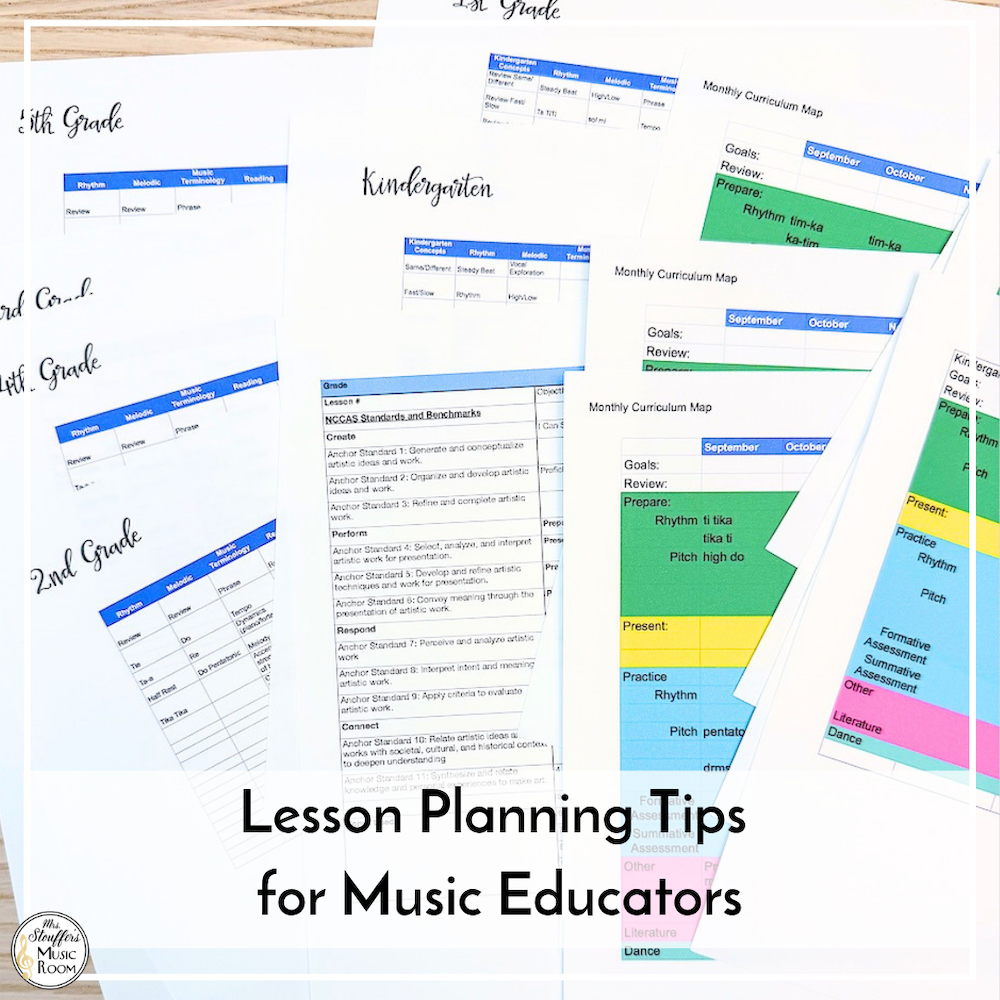
Curriculum mapping! The idea of this is taking a list of concepts that you want your students to know and plot them on a “map” of the year and through the grade levels. Start with a long list of all of the things you want students to know across all the time you have them (EX: K-5). Then put them in the order you want to teach them. From there, plot starting at the END of your time with them (EX: May of 5th grade), and plot backwards how long you think things will take you. So I’d start like this…
- Practice Ti
- Present Ti
- Prepare Ti
- Practice Fa….
Do the same for any other things you want students to know. (Definitely alternate when you present concepts between rhythm and solfege!)
It may not always look exact, and after a few years your flow WILL change as you find what works, what needs more time, and how the flow of the school year may change things.
Q: How long do you spend on one thing in a class before moving on?
The old thought was that attention spans are 1 minute for every year students are old. Realistically , students probably have shorter attention spans now. But we do need to stay on SOMETHING for a little while! Five to seven minutes is a good rule of thumb to stay on a topic. Even if in the middle of it you change up how it is being presented. For example, if you are working on a steady beat activity and have been marching, change to student led beat showing, or a different kind of movement. Even older students need a variety! If you are deep in the weeds with students, they are a little older, and they can handle
Q: What are some tips and tricks for lesson planning?
Think of a lesson as highs and lows. Move from “high concentration” (deep learning) to “low concentration” (aka the easier or more “fun” things or movement. Here’s an example:
- Opening Activity – warm up, get them singing, or engaged.
- High Concentration 1 – the most important learning you want done that day
- Movement or low concentration actvity
- High Concentration 2 – the second big learning thing of the day but not as big as the first.
- Closing – something to the the lesson together, and calm students down.
- If you have longer classes, you can always continue with the same idea of alternating higher and lower concentration activities.
A few tips:
- Don’t present 2 concepts on the same day!
- It’s a good idea to keep students working on one prepare concept and one practice. While there are times they may be working on two prepare (EX: beginning of 1st grade when you haven’t presented anything yet), you are focusing more on one than the other.
- If you are really deep in an activity, it is ok to still stop it for next time, or let it run just one or two minutes more IF the students are all engaged and it will naturally end in those couple minutes.
Q: How to keep track of what students have done?
Keep a spreadsheet with tabs for each grade level. Make a copy of this easy activity tracker here. If you need other grade levels, just duplicate a tab and rename it. You can also rename the columns for different teachers or copy/paste a column if you need for more classroom teachers per grade level.
Q: How do you organize your lesson plans?
I’m not a fan of Google Slides and Canva for lesson plans. There. I said it. Here’s the thing. I’ve literally been a substitute where the internet went out (as in the whole school) and the students had an internet based activity to do the whole time I was there. I was subbing for a band class. Luckily I knew what to do and managed to rehearse the students a little bit. But what if I wasn’t? Not only for a sub, but for me. If I plan and keep ALL my lessons online and the internet goes out because we KNOW that can and has happened to people, what am I going to pull out of my pocket then if I’m using slides to plan my lesson?
I plot my curriculum with a curriculum map, and use my concept plans to plan lessons based on where my students are at. I usually make notes in my lesson book that look like this:
O: opening lesson activity
H: Prepare low sol (Activity/ies we are doing)
L: Folk dance – name of dance
H: Practice tikatika (post office)
C: Listening with color sheet (piece/composer)
My concept plans are stored on my computer and I will jot down my lesson plans in a paper planner for the week. Call me old school but I don’t think we need slides for every part of a lesson. If you like agenda slides, definitely store offline!
As far as materials, I keep things in a Google Drive organized by concept, event, holiday, etc. not grade. Sometimes students don’t get as far. Sometimes they get further. I keep folders for letters that go home, and other things like this as well and have found doing it by grade doesn’t work as well for me.
Q: What are some quiet lesson plan ideas?
There might be a reason you need some quiet plans. Testing season, something going on in the school, the students need a day, you need a day. Check out this post for some great quiet lesson plans!
Q: How many songs should I do in a lesson?
It depends. First, even if I wasn’t following a high-low-high-low-etc concentration flow, I’d never stick to one song a whole class. Even in concert prep it’s important to keep changing the flow of activities. My attention span isn’t that good and my students’ certainly isn’t. Instead of a number, think of activities. It is alright to spend more time on one song if you are doing different things with it such as reading, playing a game, or letting students compose to it all on the same song.
Q: One of my classes needs to catch up to the others in their grade level. What are some filler lessons for the other groups?
There are a lot of activities that make great fillers but are still learning. This is where you can pull out listening lessons, feature another composer, musician, or culture, and let the student experience some new music.
This is also a great place to let students have some creative moments and try composing, making up a body percussion, a dance, or writing their own music with composition sheets.
Other options are spending a little extra time moving with some folk dances, move it’s, or reading the a music themed book that you don’t have a specific lesson plan for.
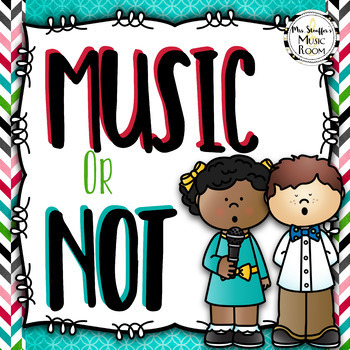
As always, Music or Not games make great fillers as well!
Have more questions?
Leave a comment! I’ll add questions to this list as I see them! 🙂
Hope this has given you a few ideas!