
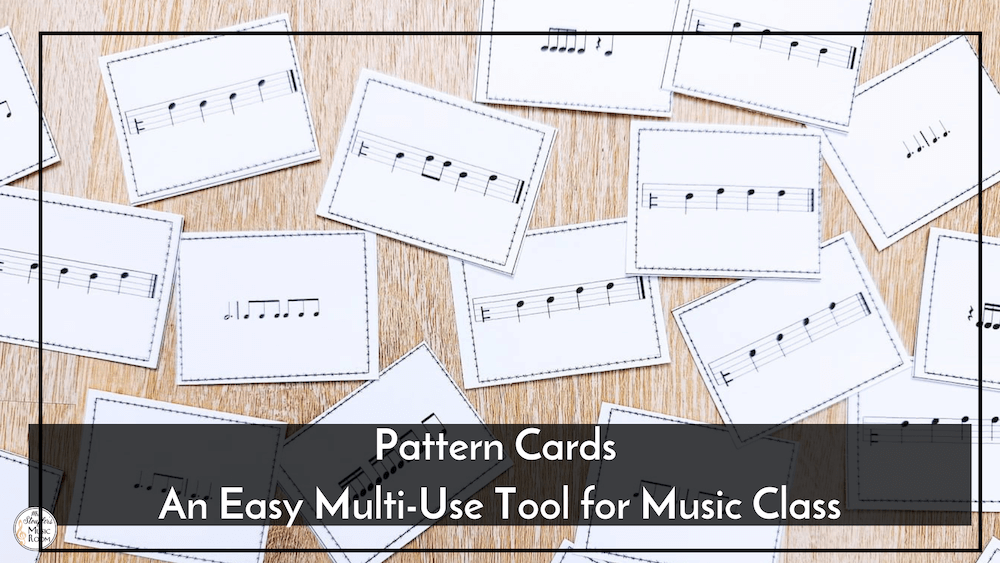
There are always cute adaptations for games out there but at the heart of them, are pattern cards. These simple cards are 4 or 8 beat rhythm or melodic patterns. There are so many ways these cards can be used in the music classroom and they are truly one of the best tools you can have. Let’s talk about what makes these an easy multi-use tool for the music class.
Set up:
1 Class set of each set of cards you are using. Some of these games don’t need a whole class set but having them ready to go means you can pull any of these games out at a moment’s notice.
Ideally, print, number on the back (EX: Set 1, set 2, etc), and put into a baggie with the name number on it. Put all the baggies in a larger one for each concept.
This is a GREAT thing to ask a parent volunteer to help with!
Four Corners
One of my favorite games is Four Corners and a perfect game for pattern cards. Back in 2011, I taught at a Montessori where one day a week I had grades 1-5 together for an hour. Not exactly an easy class to plan for. One day, the students came in and had obviously had “a day”. You know what I mean. They were begging to play a game instead of what I had dialed up. They asked to play Four Corners. I had never played it, so I asked for directions. After some explanation I ask them “but how does it involve music”? After a moment of us looking back and forth at each other, one of my favorite assessments was born.
Find out how I play Four Corners here: https://mrsstouffersmusicroom.com/music-ed-games-four-corners-a-secret-assessment/
Post Office
This game requires a little more set up than Four Corners but if you do this you can use these for other games as well. (See the race games below). For this game, each child gets an envelope with the same melodic patterns. Start with a smaller number of patterns if you wish to make things easier for students (or have students play with a partner so they can divide and conquer. BIG TIP: Number the envelope or baggie and each of the cards on the back. This is a perfect thing you can ask a parent to help set up. Ideally you need a class set for each concept you want to play with. Find out more about post office here: https://mrsstouffersmusicroom.com/music-ed-games-post-office/

Adventure Games
This is a game that involves a home pattern and other patterns to chose from. Students go on an “adventure” to create a Rondo with the home pattern being A.
How to Prepare the game
- Pick the “Home Card”.
- Practice the home card.
- Practice the other cards – you may want to start with only 3-5 cards and add more as the students get more comfortable.
To Play
- Try first with a few students that feel comfortable.
- The rhythms on the card must be read with a steady beat and without missing a beat in between cards. I like to start with three kids that feel very comfortable trying. Ask for volunteers.
- When the cards are read your home card is A. From there the students can create a Rondo with the cards of their choice. EX: ABACABADA…etc.
- Eventually work to having each student take a turn. Going down the line or around in a circle works best so that there is no break in creating the pattern.
- For an extension, have students play their rhythm and the home rhythm on percussion instruments or barred instruments to create a melodic element as well.
Race Game
There are a couple of ways to play race games.
Version A
This is essentially a variation of Post Office with an added component of a race. For this, I play in spokes. Students sit in a line to create a spoke coming away from my chair. One spoke gets one baggie/envelope with the patterns and they split the cards amongst themselves. After the Teacher sings/says a pattern, the students must find the card with the correct pattern and race to bring it to the teacher for a point for their team. Playing in the spokes makes it fair so each team has someone close and someone gradually further away. It also is a nice way to support students who may not be as comfortable reading all the patterns so they aren’t feeling discouraged.
Version B
In this version, two sets of cards (or more if needed) is placed on a surface far away. Students form teams that stand behind a starting line. The teacher reads or sings a pattern from their own set and the students must race to the other side, find the card, and come back. The first person to return the card to the line gets a point for their team.
Fun ways to change this up is to make students race with animal moves (swim like a fish, hop like a kangaroo, etc), move feet to a rhythm pattern (like ta ti-ti ti-ti ta), or use some sort of tool to move such as a sit on scooter, bounce a ball, or something along those lines or use a specific movement (EX: students must march, hop, skip, etc) .
King of the Mountain
This is the only game that doesn’t use pattern cards as is. This game is uses pattern cards that are printed with the same pattern on the front and back of the page. The paper needs to be folded in half so it stands like a tent and students on both sides of the paper can see it.
One student is chosen to be the King/Queen (Drawing popsicle sticks makes this so much easier!). The person to their right is the next highest player on the mountain (2nd place). The person to that person’s right is the 3rd, and this continues all the way around so that the person to the King’s left is in last place. The goal of the game is to work your way up to the top of the mountain and be in the king’s position.
The king starts the game by reading their card, with a steady beat, as well as the card of another player from anywhere in the circle. The player who’s card is read must then read their card and then another player’s card. This continues until someone makes a mistake. The rhythms on the card must be read with a steady beat and without missing a beat in between players.
If a player makes a mistake, they go to the bottom position in the mountain (the seat to
the king’s left) and all the other players advance up a position. The cards stay in the
same place, and do not move. Only the players change position. The king starts the play
again, once everyone has changed position. Play can continue as long as the teacher wishes.
Find out more about playing King of the Mountain here: https://mrsstouffersmusicroom.com/favorite-practice-games-king-of-the-mountain/
Baseball
Divide into teams. Have a short batting line up. The “pitcher” is the teacher for both teams. Hold up the pattern. The “batter” reads the pattern.
- 1st Base: needs time, and hesitation, but correct
- 2nd Base: immediately reads but hesitation, but correct
- 3rd Base: needs time, no hesitations, correct
- Home Run: immediately reads, correct
- Strike out: incorrect
Tip: create longer patterns, or challenges to help innings end, or let each child have a chance to ‘bat’ and that is the end of that half of the inning.
Other Ways to Use
- Arrange cards to make a new song
- Print doubles and find your match by performing your pattern as you walk around the class
- Read a card and students or a partner decode and write it
Resources
All of these games can be played with these pattern cards!
- Rhythm Practice Cards – These cards have both stick and regular notation options.
- Solfege Practice Cards – These cards have 20 melodic patterns in 3 ways – solfege letters, F-do and G-do.

Specialized Practice Cards – These ones are designed to play each specific game if you want a little variety in how the games look.
- Four Corners Cards
- Post Office Cards
- Adventure Cards
- Snowflake Expedition (A race game)
- King of the Mountain (premade so all you need to do is fold them in half)
Teacher Tip! With the exception of King of the Mountain, print 2 or 4 pages to a sheet when you do these for smaller cards and less waste.
I hope you have gotten some great ideas from this!