
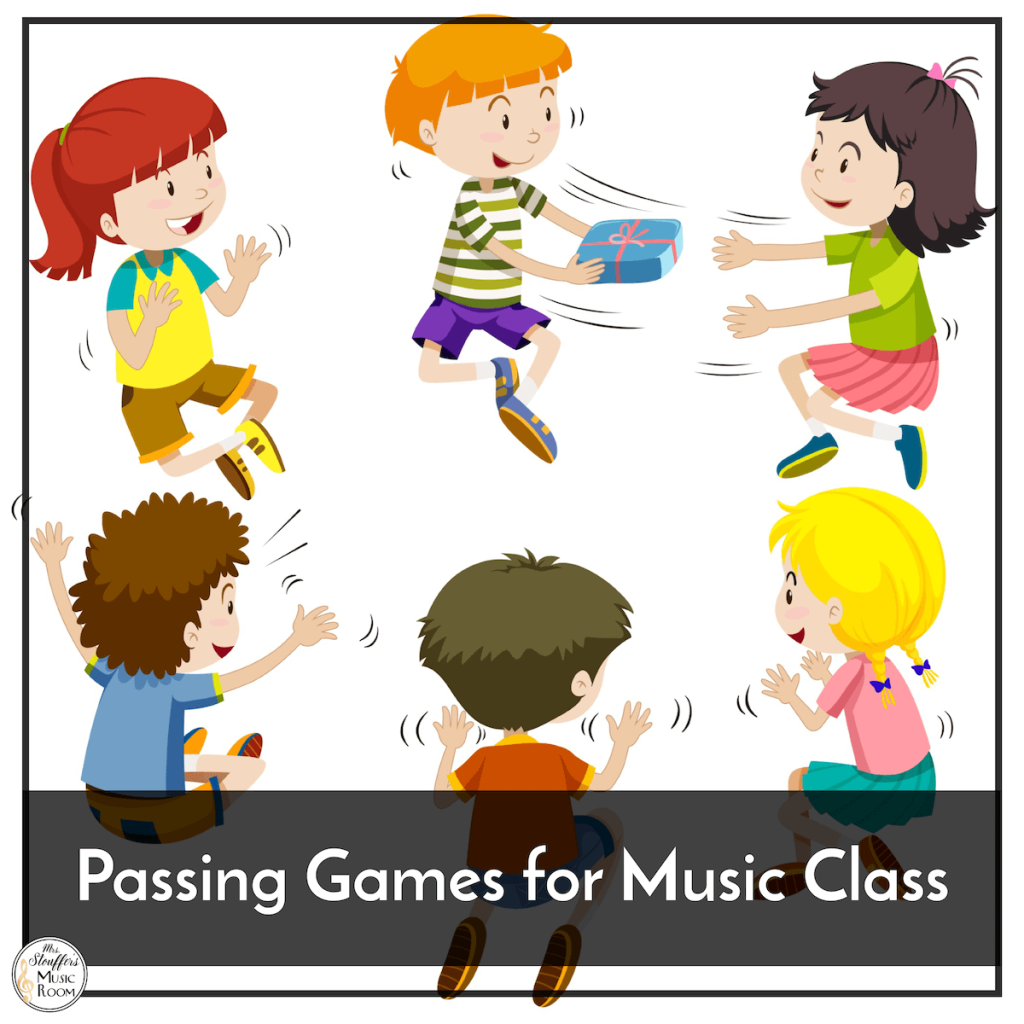
Passing games are some of the most engaging student activities. Everyone is involved, the games are FUN, and then of course there is the opportunity in some games to either guess who has the object, or to get a classmate out. But passing games aren’t just an “explain and go” sort of activity. There are skills students need to have, steps to work to, and ways to build to more difficult games. This sequence will help your students learn to play their favorite games!

Like everything in life, and in music class, there are prior skills students need to have to be able to play passing games. The big two that students need are being able to keep a beat and crossing the midline.
The importance of this, no matter how high we hold it, seems underrated. It’s important for pretty much any other musical skill (pitch is great but if you can’t keep a beat, your songs are going to sound a little funky anyway), for reading, and for being able to bust a move on the dance floor at your second cousins wedding when you are 30. In passing games, it is essential that students are able to keep a beat, otherwise the games won’t work they way they are intended.
This doesn’t SEEM like a big deal, but it is. Being able to use your hands across the side of your body to touch your other arm, toe, or any other task is a skill that needs building. Kids start this skill when they are infants, and there is some level of bilateral mastery at ages 3-4, but it really refines itself around 8 or 9. So working on passing games with Kindergarteners can be extremely frustrating for both beat and midline reasons. Here’s some of the skills that come with midline crossing. Here’s a little more info about midline. If this is an issue, talk to your school/district Occupational Therapist.
Build this with a million beat keeping activities. Even older students need beat keeping activities. It should be part of our lives every day to really help solidify this. It doesn’t need to look the same for every grade (and shouldn’t), and definitely doesn’t need to be presented that way to older students. If you need some help, here are a few blog posts working with the beat
Teacher Tip: When patting the beat, it should be silent to not change the tempo.
Moving their hand while keeping the beat is the next step in the lead up to passing games. Working with Steady Beat cards while singing is a simple and easy way to practice this. If you are looking for a great game, Zapatito Blanco or play similarly to the chant Cinderella at the Ball.
Bee Bee Bumblebee is my favorite game for this. Students must keep at beat on their classmate’s shoulders while they walk around the outside of the circle. Find out more about this game here.
This is the classic passing game. Beat passing games like Freddy Oaka, or Down by the Banks as well as games like A Qua Qua, Button You Must Wander, or The Nickel are what we think of when we think of passing games. Things to keep in mind:the object matters. Smaller objects will be more difficult. Objects on a string (Black Snake or Who Has the Ring) will require a little more skill as well.
Now it gets VERY complicated. If everyone is passing something, it’s easy to get out of sorts. Ask a group of music teachers what happened the first time they played Al Citrón and know that most every group I’ve ever been in that played this game got off. If all the students are passing something like in this game or Obwisana or Pass the Shoe, there is a next level skill of being able to remember a pattern as well as know when to move the object.
When playing passing games, it’s important to not just hand kids a button and say go. You need to build the physical movement of passing the object.
Looking for fun passing games to try this on?
Check out this blog post.
I hope this has given your passing games a boost!


One Response
Dearest Melissa,
Thank you for your exceptional work!
Just today I had my Kindergarten class to learn how to pass an object. We had the Pass the Beanbag song. The Kindergarteners are learning the musical opposites Fast and Slow, also getting faster and getting slower. As you have said before- yes! – million times to be! I love watching their giggles though.
As always with gratitude!
Blessings!!